Yatai
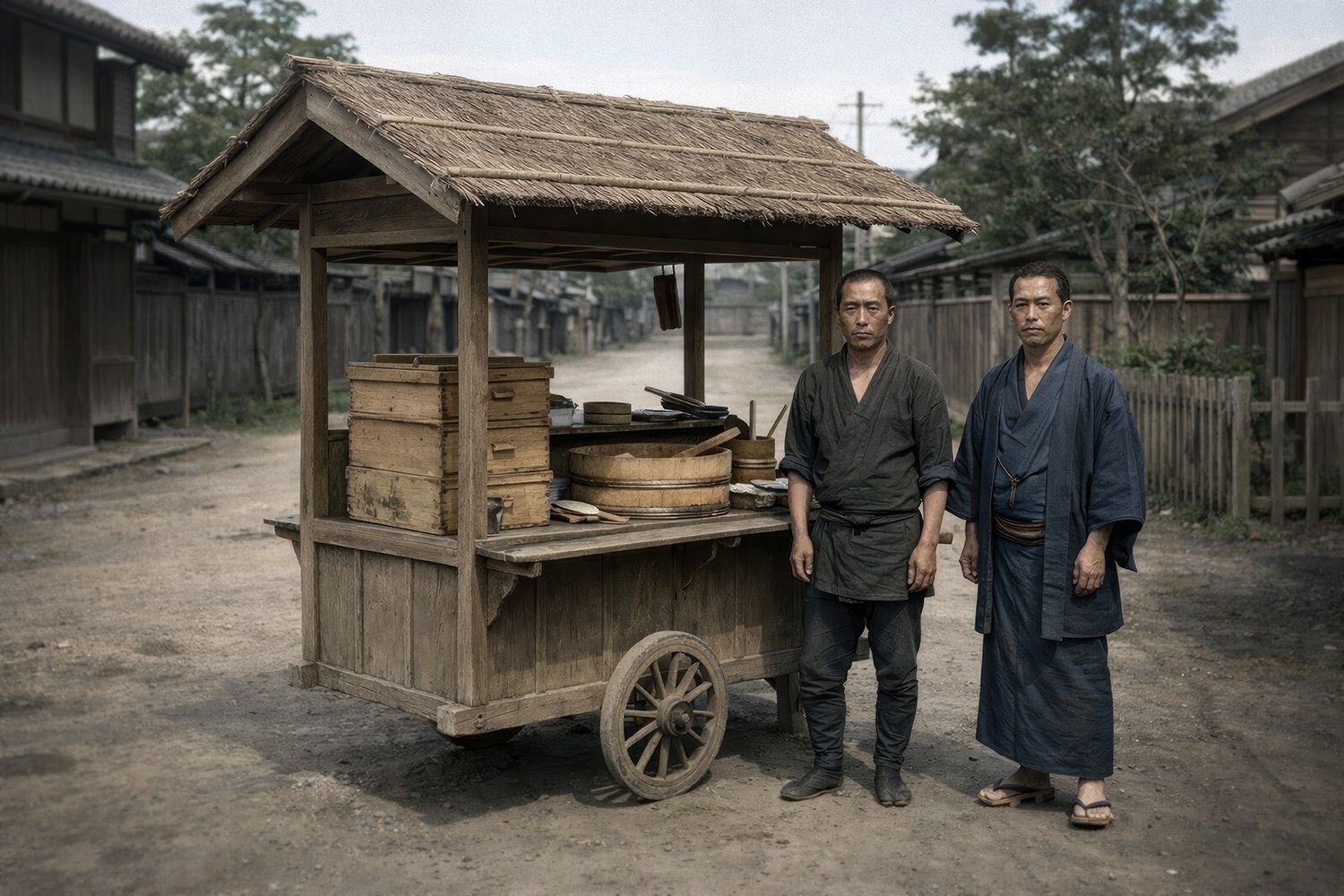
A yatai is a mobile street stall: under the thatched roof, a work surface, stacked wooden boxes, and a hangiri (wooden tub for cooling sushi rice) form a compact setup for preparing sushi on site.
AI-generated photo: Mobile sushi cart (yatai) with two vendors and wooden boxes
Yatai (屋台, literally "roof-stand") denotes a mobile street stall with a roof and work surface at which food is prepared and sold to standing customers. In the history of sushi, the yatai marks the place where nigirizushi (握り寿司) became everyday fare: not in a restaurant, but on the street, at a wooden stand under the open sky.
Etymology
The compound consists of 屋 (ya, roof, house) and 台 (tai/dai, stand, platform). The earliest meaning refers to a small, house-shaped platform — originally a portable structure for deity figures in festival processions. In the Nippo Jisho, the Japanese–Portuguese dictionary of 1603, yatai already appears as a term for a built structure.1 The transfer to a street stand for food sales is documented from the late eighteenth century onward. The earliest known culinary usage appears in Nanpin Kairai (南品傀儡, 1791), a sharebon (洒落本, Edo-period pleasure-quarter fiction).2
Historical Development
Origins in the eighteenth century
Edo was a city of single men. Under the eighth shōgun, Tokugawa Yoshimune, the population surpassed one million, with roughly half accounted for by the samurai contingent of the sankin-kōtai (参勤交代) obligation — predominantly men without households. Among the townspeople, too, the sex ratio ran approximately two to one in favor of men.3 Demand for readily available street food was correspondingly high.
The forerunners of the yatai were the furiuri (振り売り), itinerant vendors who carried their goods on shoulder poles through the alleyways. According to the scholar Kitamura Intei, yatai as stationary street stands appeared during the An'ei era (1772–1781) and spread rapidly from the Tenmei era (1781–1789) onward.3
Sushi, tempura, and soba — the three pillars of Edo street food
Three types dominated among the yatai: sushi, tempura, and soba. Kitakawa Morisada recorded in his encyclopedic work Morisada Mankō (守貞謾稿, completed 1853) that yatai stands in Edo were "exceedingly numerous" and that sushi and tempura were their principal goods. In busy districts, three to four such stands occupied a single city block.4
The three street cuisines differed in construction. Sushi and tempura yatai were stationary structures: wooden stands set on the ground and relocated as needed. Soba yatai, by contrast, were portable rigs that the vendor carried on his shoulders through the streets, setting them down at street corners.3
Layout of a sushi yatai
A typical sushi yatai of the Edo period consisted of a wooden work platform with a roof, a tsukedai (つけ台, serving counter) at the front, and a half tatami mat behind it on which the craftsman sat while working.5 Customers stood in front of the stall and ate standing — an arrangement that seems incongruous today, but was standard at the time: the customer stood, the chef sat. This working posture persisted well into the Taishō era. Only after the Great Kantō Earthquake of 1923 did the standing working position gradually become the norm.5
The sushi sat pre-portioned on the tsukedai. Customers reached for pieces and ate with their hands — chopsticks were not available at the stand. The pieces were two to three times the size of today's nigiri and intended as a snack, not a full meal. All neta were pretreated: cured in vinegar, marinated in soy sauce, simmered, or cooked — raw fish played no role, as refrigeration did not exist.6 Only over time did the practice shift to made-to-order preparation, which reduced waste and improved freshness.7
From street stand to shop
The yatai also served as an entry point into the trade. Those who had built a customer base and accumulated capital aspired to the next step: a tokomise (床店), a ground-level shop in which the yatai structure stood under a permanent roof.5 The stage beyond was the uchimise (内店), a full establishment with its own kitchen. Uchimise conducted their business primarily through deliveries and takeout orders; the yatai remained the site of direct, on-the-spot consumption.8
Through the Meiji and Taishō periods, both forms existed side by side. From the late 1930s onward, street yatai came under increasing restrictions through traffic and hygiene regulations. After World War II, they vanished from the streetscape of most cities — with one prominent exception.
The postwar era and Fukuoka
In the first postwar years, improvised yatai sprang up across the country at black markets. Repatriates from overseas territories, war widows, and people who had lost their shops operated mobile food stalls as a means of livelihood. In most cities, these stands disappeared as the economy recovered. In Fukuoka, however, the yatai endured and became a cultural institution. At their peak around 1970, over 400 stands operated in the city.9
In 2013, Fukuoka became the first Japanese municipality to enact a yatai basic ordinance (Fukuoka-shi Yatai Kihon Jōrei), providing the street stands with a legal framework. Since 2014, new stall locations have been allocated through a public application process. As of 2024, approximately 100 yatai operated in Fukuoka, roughly one-third of them awarded through that process.9
References and Further Reading
- [1]『屋台 — デジタル大辞泉』 (Yatai — Digital Daijisen). Weblio(小学館 デジタル大辞泉). Source retrieved 2/18/2026
- [2]『屋台(ヤタイ)とは? 意味や使い方』 (What Is Yatai? Meaning and Usage). コトバンク(小学館 デジタル大辞泉). Source retrieved 2/18/2026
- [3]飯野亮一. 『江戸時代の移動式コンビニ!天ぷら、すしを誕生させた屋台文化とは?』 (Edo-Period Mobile Convenience Stores! The Yatai Culture That Gave Birth to Tempura and Sushi). エース分室(エースコック株式会社)、 2024. Source retrieved 2/18/2026
- [4]喜田川守貞. 『守貞謾稿 巻之六 生業』 (Morisada Mankō, Volume 6: Livelihoods). 国立国会図書館デジタルコレクション. 1853
- [5]福地享子. 『江戸時代から現代まで。移り変わるすし屋のスタイル』 (From Edo to Today: The Changing Styles of Sushi Restaurants). 料理王国 (150). 2006
- [6]『すしの歴史(4) 江戸の握り寿司文化と華屋与兵衛』 (History of Sushi (4): Edo Nigirizushi Culture and Hanaya Yohei). ミツカン(Mizkan Holdings Co., Ltd.). Source retrieved 2/18/2026
- [7]『江戸時代の暮らし』 (Life in the Edo Period). 魚竹寿し. Source retrieved 2/18/2026
- [8]『すしの歴史 — 明治、大正時代の江戸前すし店』 (History of Sushi — Edomae Sushi Restaurants in the Meiji and Taishō Eras). 全国すし商生活衛生同業組合連合会. Source retrieved 2/18/2026
- [9]『HISTORY — 屋台の歴史』 (HISTORY — History of Yatai). YATAI KEIJI(福岡市屋台公式サイト). Source retrieved 2/18/2026
- 『江戸時代の東京から始まった寿司屋の歴史』 (The History of Sushi Restaurants Beginning in Edo-Period Tokyo). ホームメイト(東建コーポレーション). Source retrieved 2/18/2026