Shokunin
Shokunin (職人) is a Japanese term for a person who makes or processes things through learned, refined manual skill.1 In the sushi world, the word denotes the trained sushi craftsman — a figure defined by technique, material knowledge, and decades of practice. No single English word captures the full weight of the Japanese term; "artisan" and "craftsman" are approximations. In English-language writing on Japanese food culture, shokunin has gained currency as a loanword, often glossed as "artisan" or "master craftsman."
Etymology
The word combines the characters 職 (shoku, office, profession, function) and 人 (nin, person). It derives from the medieval concept of shiki (職) — a legal construct of the Japanese feudal order designating a function-bound entitlement together with the income it generated.1 A holder of such a shiki was a shokunin: originally an officeholder in the administrative apparatus of estates, only later a manual craftsman in the modern sense.
The Nippo Jisho (日葡辞書), the Jesuit Japanese-Portuguese dictionary of 1603–04, already records the definition "a person who practices a craft as a profession" (kōsaku o shoku to suru hito).2 This core meaning has not changed since.
From Feudal Official to Craftsman
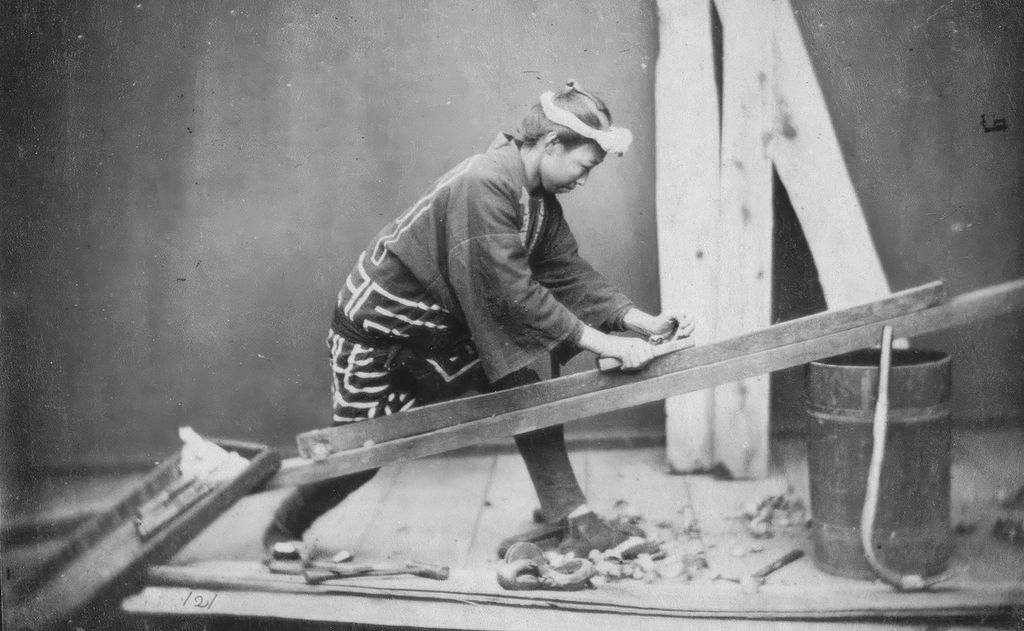
A daiku (大工, carpenter) planing a beam. Carpenters, along with plasterers and scaffolders, were considered one of "the three flowers of Edo" (Edo no san shoku) and embodied the ideal of the shokunin — the craftsman who masters his trade through years of practice.
Doctor J. Johnsson. Japanese workmen: A carpenter working, Japan.. Flickr
In the early medieval period (Kamakura era, 1185–1333), shokunin referred primarily to administrative officials on estates — provincial functionaries, minor stewards, officeholders in the service of aristocracy and clergy. The link to craft arose because smiths, casters, bow-makers, and musicians also had their activities recognized as shiki: a protected professional function carrying privileges such as tax exemption.3 In the shokuninuta'awase (職人歌合, poetry competitions of the trades), produced from the 13th through the 16th century, 142 occupational groups appeared — from carpenters and fish sellers to fan-makers, diviners, and priestesses.4 The category shokunin was broad in this period, encompassing craftsmen, merchants, artists, and religious specialists alike. The more common expression for the group at the time was michi michi no mono (道々の者, "people of the various ways").
Only from the Edo period (1603–1868) did the term narrow to its present meaning: the manual craftsman who masters a specific trade. The Tokugawa status system ordered society into four classes — warriors (shi), farmers (nō), artisans (kō), merchants (shō). The artisans (kō) were the shokunin in the stricter sense. In Edo alone, some 140 specialized craft trades existed.5 The three most esteemed among them — carpenter (daiku), plasterer (sakan), and scaffolder (tobi) — were known as "the three flowers of Edo" (Edo no san shoku).
Shokunin katagi — the craftsman's temperament
The compound shokunin katagi (職人気質, read shokunin katagi, not kishitsu) describes the temperament traditionally ascribed to the artisan class: pride in one's skill, uncompromising care, willingness to accept financial disadvantage when the quality of the work demands it.6 The Sei-Sen-Ban Nihon Kokugo Dai-Jiten (精選版日本国語大辞典) records the novel Fūryūma (風流魔, 1898) by Kōda Rohan as the earliest attested use. The term describes an attitude that may appear stubborn or obstinate from the outside but is rooted in a refusal to compromise on work.
In the sushi world, this attitude is not a metaphor. The saying meshi-taki san-nen, nigiri hachi-nen (飯炊き三年、握り八年 — "three years cooking rice, eight years forming") summarizes the traditional path of training: a decade or more under a master's guidance, the early years devoted to observing, cleaning, and cooking rice before an apprentice touches neta for the first time. This structure is not mere ritual. The gradual approach to the counter — from washing dishes through preparing ingredients and working at the preparation board to finally forming nigiri at the tsukeba (付け場) before the guest — constitutes an implicit curriculum: material knowledge, sensory judgment, pace, the ability to read the rhythm of an evening.
Shokunin and itamae
In common usage, shokunin and itamae (板前) are often used interchangeably in sushi contexts. The terms mark different perspectives, however. Itamae — literally "before the board" — designates the position: the chef who works at the cutting board and faces the guest. The term is functional and applies across Japanese cuisine. Shokunin, by contrast, emphasizes identity: the craftsman who masters a trade and refines his skill over years. A sushi shokunin is also an itamae, but not every itamae identifies as a shokunin. In high-end sushiya, the designation shokunin expresses professional ethos and self-understanding, not a formal title.
The third common designation, taishō (大将), refers to the head of an establishment — the senior chef responsible for sourcing, kitchen, and guest management. A taishō is typically a shokunin who runs his own sushiya.
References and Further Reading
- [1]コトバンク編集部. 『職人』 (Shokunin). コトバンク (小学館デジタル大辞泉 / 精選版日本国語大辞典 / 世界大百科事典). Source retrieved 2/18/2026
- [2]精選版日本国語大辞典編集部. 『職人 (精選版日本国語大辞典)』 (Shokunin (Sei-Sen-Ban Nihon Kokugo Dai-Jiten)). 小学館. Source retrieved 2/18/2026
- [3]網野善彦. 『職人 (改訂新版世界大百科事典)』 (Shokunin (Revised World Encyclopedia)). 平凡社 (改訂新版世界大百科事典). Source retrieved 2/18/2026
- [4]Wikipedia日本語版. 『職人歌合』 (Shokuninuta'awase). ウィキメディア財団. Source retrieved 2/18/2026
- [5]Wikipedia日本語版. 『職人』 (Shokunin). ウィキメディア財団. Source retrieved 2/18/2026
- [6]コトバンク編集部. 『職人気質』 (Shokunin Katagi). コトバンク (小学館デジタル大辞泉 / 精選版日本国語大辞典). Source retrieved 2/18/2026