Shiroita Kombu
- バッテラ昆布batterakonbu
- 白昆布shirokonbu
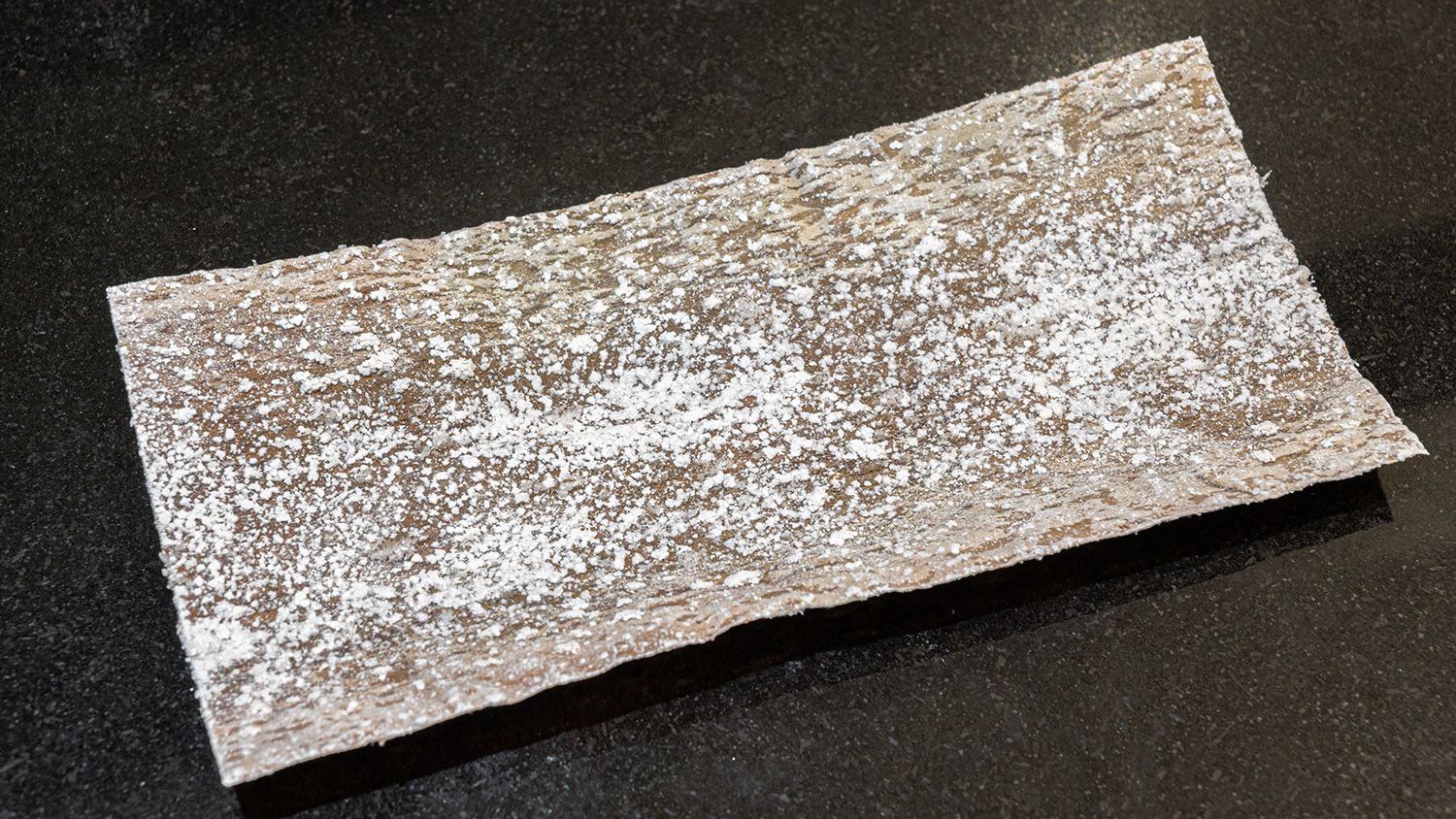
Shiroita Kombu. © SUSHIPEDIA
Shiroita kombu (白板昆布, white-board kelp) is a pale, thin sheet of kombu that remains as the central core after the outer and inner layers of a dried kombu strip have been shaved away to produce oboro kombu (おぼろ昆布, kombu ribbons) and related products. The core is cut to standardized rectangular sizes and sold for culinary use.1, 2 The same material is also known as battera kombu (バッテラ昆布), after its signature application. The thin sheet is laid across the top of battera (the Osaka-style pressed mackerel sushi, whose name comes from Portuguese bateira, "small boat") and, by extension, across other forms of oshizushi (押し寿司, pressed sushi).2, 3
Producing shiroita kombu is hand craft. A dried kombu strip is first softened by soaking in vinegar; an artisan then shaves it, layer by layer, with a specialized plane known as an akita. The plane's name refers equally to the tool and to the edge-bending preparation performed before each shaving session, which produces a blade both sharp enough to take ribbons measurable in hundredths of a millimeter and flexible enough to ride the curved surface of the kombu.4, 5 The technique depends on the 600-year tradition of forged-blade craft in Sakai, near Osaka, where the specialized planes are made, and the craft is practiced by a small number of artisans in Sakai itself and in Tsuruga, on the Fukui coast.4, 6 Master artisans record thicknesses as fine as 0.01 mm on the outermost shavings; each kombu strip yields only a modest remainder of core material, so shiroita kombu is treated as a premium by-product of the shaving process, and supply is increasingly constrained as the number of practicing artisans declines.2, 5
Before use on sushi, the sheet is simmered in sweet vinegar (amazu, 甘酢), which softens it and develops its characteristic translucent jade-green color.3, 7 On battera and other pressed sushi the prepared sheet performs several linked jobs at once: the simmered kombu contributes free glutamate to the saba (鯖, chub mackerel) or other neta (sushi toppings) below it, shields the fish from drying out, and gives the finished piece its distinctive glossy green top layer.7 On sabazushi (鯖寿司, pressed mackerel sushi) in particular, the sheet is understood as integral to the finished dish rather than as decoration, and the piece is served with it in place.7
Beyond pressed sushi, shiroita kombu appears in a small set of related applications: it is used occasionally for kobujime (昆布締め, kelp curing), and in Kansai it is placed as an auspicious decoration on kagamimochi (鏡餅, the stacked rice cakes offered for the New Year).3
The craft's historical footprint follows the Edo-period kitamaebune (北前船, northbound coastal-trade ships), which carried Hokkaidō kombu south along the Sea of Japan coast to Tsuruga and then onward to Osaka. The influx of Hokkaidō kelp, together with Sakai's existing knife industry, turned the Osaka region into the country's main center for hand-shaved kombu products, a role it still holds.5, 6 Established Sakai producers work preferentially with ma kombu (真昆布, Saccharina japonica) from the Shirokuchi-hama coast of southern Hokkaidō, a grade historically submitted to the imperial court and the shogunate as kenjō kombu (献上昆布, tribute kombu).4
The name is descriptive. 白 (shiro) means "white"; 板 (ita) means "plank" or "board"; and 昆布 (konbu) is the kelp. Taken together, 白板昆布 names the finished product by its appearance — a pale, thin, board-like sheet of kelp — and distinguishes it from the dark shavings (kuro oboro, 黒おぼろ) and the lighter inner shavings (tahaku oboro, 太白おぼろ) that precede it in the shaving sequence.2, 5
References and Further Reading
- [1]『白板昆布』 (Shiroita Kombu — Encyclopedia Entry). 平凡社 (Heibonsha). Source retrieved 4/24/2026
- [2]『昆布の種類(昆布いろいろ)』 (Types of Kombu (Kombu Varieties)). 日本昆布協会 (Nihon Kombu Kyōkai, Japan Kombu Association). Source retrieved 4/24/2026
- [3]『白板昆布』 (Shiroita Kombu (Battera Kombu)). 小倉屋松柏 (Oguraya Matsuhaku). Source retrieved 4/24/2026
- [4]『こだわりの手すき昆布』 (The Uncompromising Tradition of Hand-Shaved Kombu). 郷田商店 (Goda Shōten). Source retrieved 4/24/2026
- [5]『1枚の昆布から極上の“厚み”を削る。現代の名工・手すき昆布職人・別所昭男さん/福井県敦賀市』 (Shaving Ultimate Thickness from a Single Sheet of Kombu: Master Hand-Shaving Kombu Artisan Bessho Akio, Tsuruga, Fukui). NIHONMONO, 2024. Source retrieved 4/24/2026
- [6]『昆布』 (Kombu — Traditional Crafts of Sakai). 堺伝匠館 (Sakai Densankan). Source retrieved 4/24/2026
- [7]『白板昆布って何?鯖寿司にのっている昆布は、味の縁の下の力持ち』 (What is Shiroita Kombu? The Kombu on Saba-zushi, the Unsung Hero of Flavor). 華ずし (Hanazushi)、 2022. Source retrieved 4/24/2026
- 『【ゆう心×究極の血抜き・津本式】最後の晩餐を選べるなら、僕はここに来る!』 (Yūshin × Ultimate Bloodletting · Tsumoto-Shiki: If I Could Choose My Last Supper, I Would Come Here!). ルアマガプラス (Luremaga Plus, 内外出版社). 2019. Source retrieved 4/24/2026
- 津本光弘. 『魚食革命『津本式と熟成【目利き/熟成法/レシピ】』』 (Fish Food Revolution: Tsumoto-Shiki and Aging — Selection, Aging Methods, Recipes). 内外出版社 (Naigai Shuppansha, Luremaga Books 11). 2020