Pichit Sheet – Explanation and Review
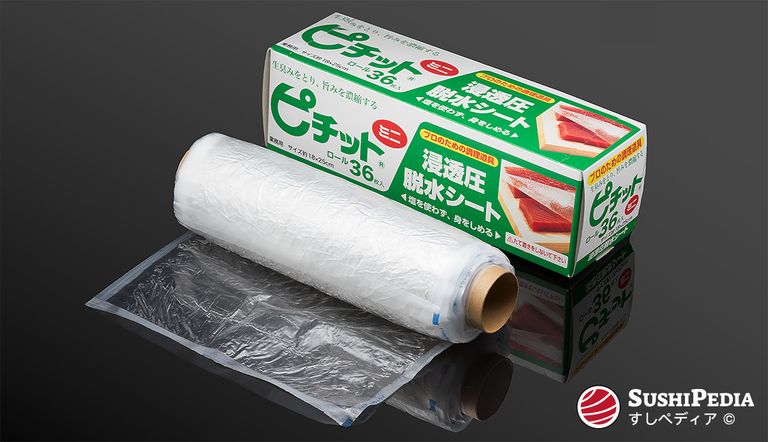
This article describes how Pichit sheets work and what results we observed after more than one year of regular use.
What are Pichit sheets?
Pichit sheet (pichitto shīto, ピチットシート) is a contact dehydration sheet manufactured by the Japanese company Okamoto Industries, Inc. (オカモト株式会社). Okamoto was founded in Tokyo in 1934 and is a diversified manufacturer of plastic films, rubber products, and consumer goods; Pichit belongs to the company's food hygiene product line. The sheet draws water from food—particularly fish, shellfish, and meat—through osmotic pressure. Some low-molecular-weight odor compounds may also migrate into the sheet with the released moisture. In professional Japanese kitchens and among dedicated home cooks, it serves as a preparation tool for sushi and sashimi.
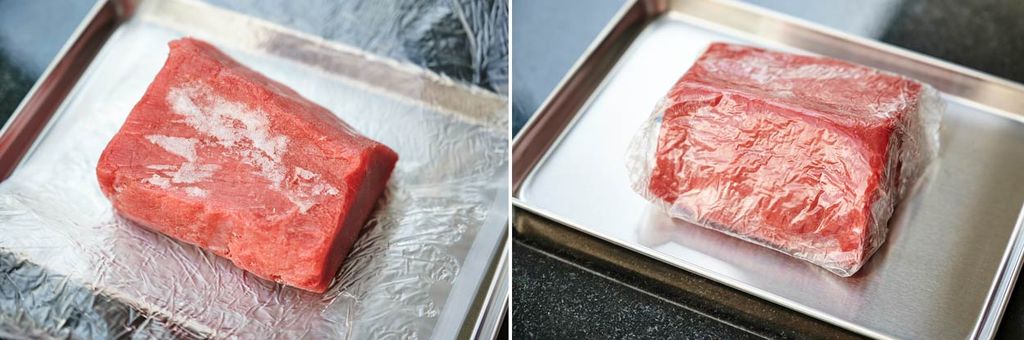
Pichit sheet can absorb drip released during thawing and keep the surface of tuna drier.
SUSHIPEDIA. Thawing tuna with Pichit sheet. All rights reserved
Pichit sheet first came to our attention during a stay in Japan. One evening in spring, we sat at the counter of a small sushi restaurant in Shimoda—a place with no exterior signage and only a few seats facing the chef. Between courses, the sushi shokunin (鮨職人, sushi chef) returned with a saku (柵, rectangular fillet block) and two fillets wrapped in a semi-translucent sheet. He explained that he used the sheet to prepare neta (ネタ, sushi toppings), depending on the fish, for one hour or overnight. He used the sheet predominantly when thawing frozen tuna, as it absorbed drip released during thawing and helped keep the surface drier. After returning home, we used the sheet regularly for over a year; the results are described below.
How does Pichit sheet work?
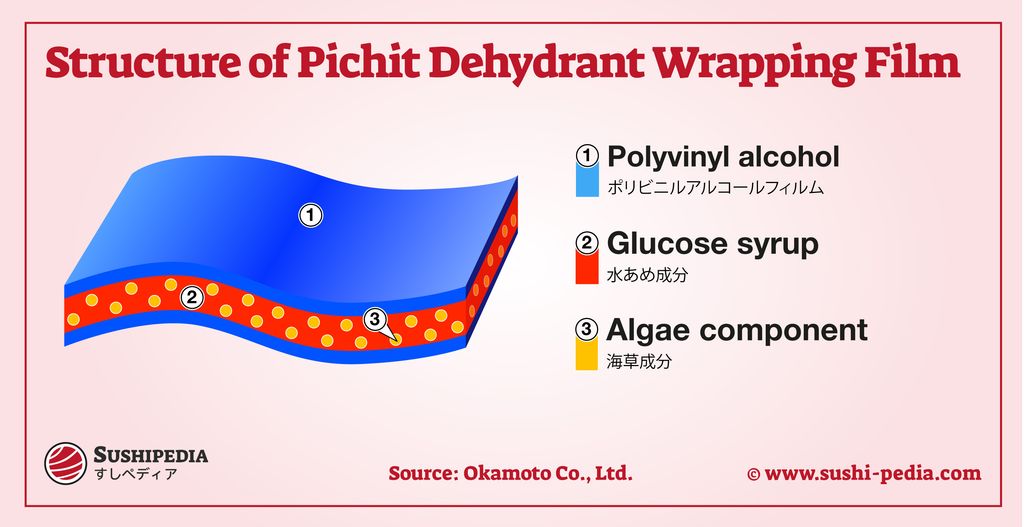
SUSHIPEDIA. Structure of Pichit sheet. All rights reserved
Pichit sheet consists of two semipermeable polyvinyl-alcohol membranes. Enclosed between them are a highly osmotic starch syrup (mizuame, 水飴), which acts as the dehydration agent, and a seaweed-derived thickener (糊料, kōryō) that increases the syrup's viscosity.1 Sodium alginate is one of several thickening agents disclosed in the foundational patent family.2
When food is wrapped in the sheet, the high solute concentration inside the sheet creates an osmotic gradient between the food surface and the starch syrup layer. Water migrates through the semipermeable membrane into the sheet. Some low-molecular-weight odor compounds may also move with the released moisture.3, 4
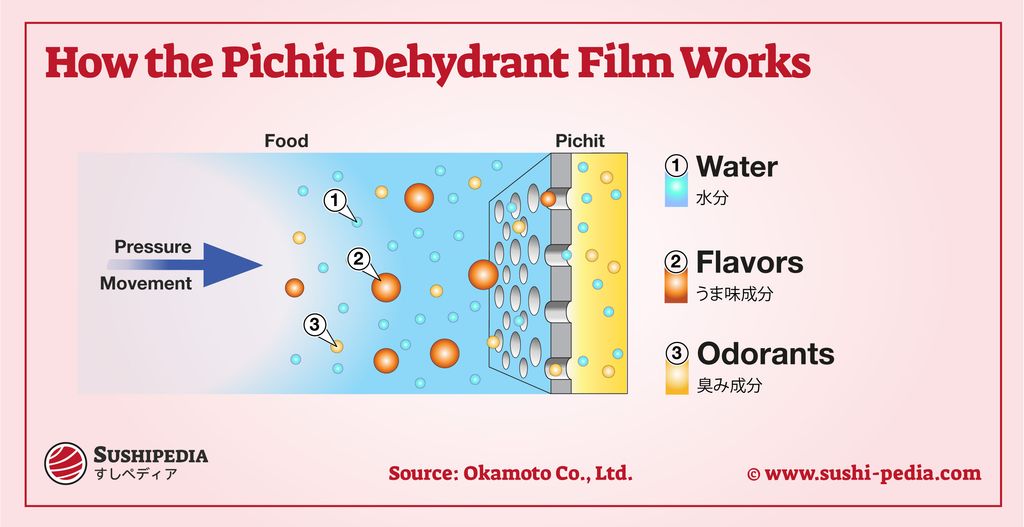
SUSHIPEDIA. How Pichit sheet works. All rights reserved
The degree of dehydration depends on the ingredient's moisture content. The visible drying effect is stronger in lean cuts—such as flatfish—than in fatty cuts. Application time and drying intensity vary according to species, cut thickness, fat content, and origin. Pichit sheet can also be used during the refrigerated thawing of frozen foods, where it continuously draws moisture from the surface.5 For the production of himono (干物, dried fish), the fish can be salted before wrapping to increase moisture release. With longer application times, Pichit sheet can also be used in the production of dried fish and other dried foods.6
What effects does contact dehydration have?
Reduction of water content
Water content significantly affects the sensory properties of raw fish. Available surface moisture can support microbial activity and accelerate quality loss when fish is not handled under proper refrigerated conditions. In some applications, reduced surface moisture can also improve seasoning penetration, as shown for tuna in contact-dehydration experiments.3
Reduced drip loss during thawing
Drip loss occurs primarily in foods that have been frozen and release a portion of their tissue fluids during thawing. The extent is largely determined by the freezing method and its speed.7 High drip loss can impair flavor and texture. When substances that promote lipid oxidation are present in the tissue, off-odors and diminished flavor may result. By continuously removing surface moisture during thawing, the sheet can help reduce drip accumulation and may help slow some quality changes under proper refrigerated storage.5, 8, 9
Pichit sheet vs. dry aging
Pichit sheet dehydrates through osmotic pressure. This mechanism differs fundamentally from enzymatic aging (dry aging), where biochemical changes alter texture and flavor over time. Although Pichit sheet reduces water content, it should not be equated with aging—moisture loss is one part of an aging process, not its defining mechanism.
Pichit sheet vs. shiojime / satōjime
In the preparation of sushi and sashimi, it is common to dust ingredients with salt or sugar before processing. Salt curing is called shiojime (塩締め); sugar curing, satōjime (砂糖締め). Dusting draws water and other substances from the surface, which can improve flavor and odor. However, this produces a potentially unwanted salty or sweet aftertaste. To remove it, the surface is subsequently rinsed with water or sake (酒). Rinsing, however, allows some moisture back into the fish.
Pichit sheet can reduce the need for salt or sugar when the main goal is moisture removal rather than seasoning. It keeps the flavor more neutral, although the result depends strongly on the fish. For odor reduction—particularly in fish with a pronounced inherent smell—Pichit sheet can serve as an alternative to salt treatment (shiojime).
Pichit sheet vs. kobujime
In kobujime (昆布締め, kelp curing), fresh ingredients—typically fish or seafood—are placed between layers of kombu (昆布, kelp). Kombu transfers glutamate-rich flavor compounds to the surface of the fish while also drawing out moisture.
The mechanism of Pichit sheet differs fundamentally from the processes involved in kobujime. Both methods can produce a firmer texture, but the flavor profile differs clearly. Pichit sheet can reduce odor-active compounds but adds no external flavor; unlike kombu, it does not transfer glutamate-rich kelp flavor to the fish.
Product variants
Okamoto lists three main Pichit sheet variants, which differ in absorption strength.
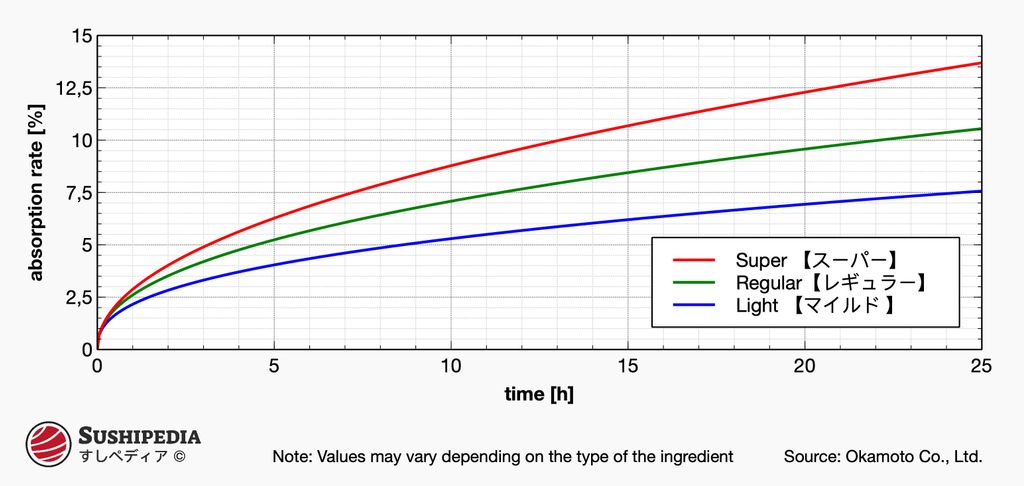
SUSHIPEDIA. Absorption rates of Pichit sheet variants. All rights reserved
Mild (low absorption)
The mild variant (マイルド <低吸収タイプ>) has the lowest absorption rate of the three. Okamoto markets this variant explicitly for sushi neta and sashimi as well as for cold storage and short-term handling of fresh ingredients.10
Regular (high absorption)
The regular variant (レギュラー <高吸収タイプ>) absorbs more moisture than the mild type but less than the super type. According to Okamoto, it is intended for cooking preparation, freezing, thawing, and longer drying processes.10
Super (super-high absorption)
The super variant (スーパー <超高吸収タイプ>) has the highest absorption rate of the three. According to Okamoto, it is suited for the production of dried fish and dried foods.10
How to apply Pichit sheet
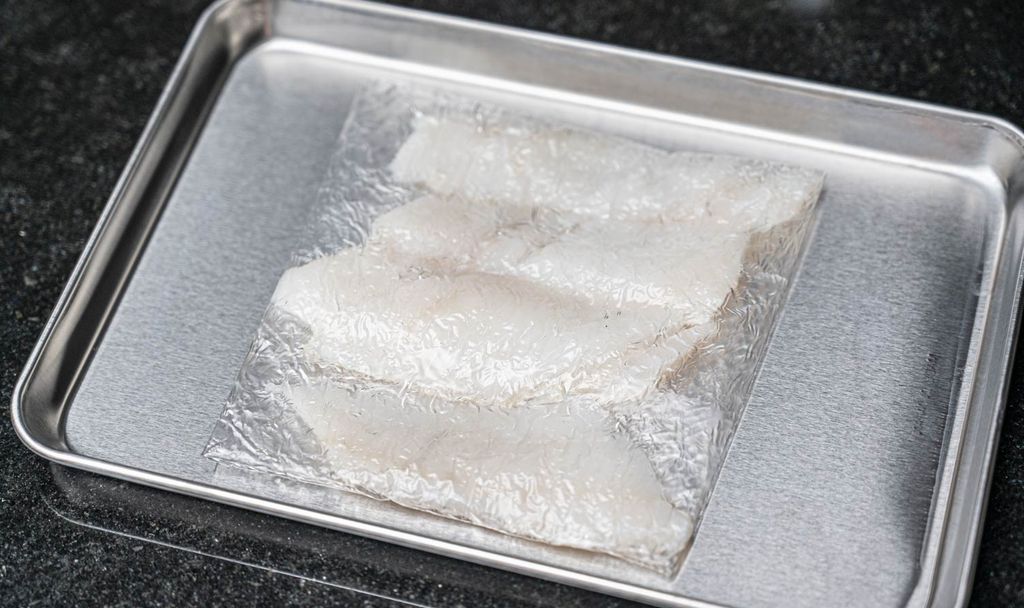
SUSHIPEDIA. Use of Pichit sheet for sashimi. All rights reserved
Pichit sheet can be used for whole fish, though better results are achieved with thin fillets, saku blocks, or pre-sliced cuts—particularly when preparing sushi and sashimi. The fish should be thoroughly cleaned, with residual blood, bloodlines, and bruised tissue removed.
The sheet must not be cut, as the contents would leak out. Both sides of the sheet are identical. The flesh is placed on the sheet and fully wrapped, with the sheet pressed as closely as possible against all sides. Excess sheet material can be folded or rolled over itself. Multiple cuts can also be processed simultaneously by layering them between sheets, with Pichit alternating with food in a mille-feuille arrangement.
The wrapped fish is stored under refrigeration at approximately 3 °C. Over time, water accumulates inside the sheet. Storage duration depends on the desired result and the type of cut. For long applications, the sheet may be replaced with a fresh one when surface moisture remains; this maintains the dehydration gradient over extended times. Larger fillets or saku blocks require a longer application time than smaller pieces. When unwrapping, the surface may adhere slightly to the sheet; careful and slow unwrapping is therefore advisable. Once the desired dryness is reached, the fish can be prepared directly or flavored with additional ingredients.
Practical reference times
The following times reflect our own use of the Regular variant under refrigeration at approximately 3 °C. These times assume fish suitable for raw consumption and continuous refrigeration. They are texture guidelines, not food-safety guidelines.
| Cut | Fat content | Duration |
|---|---|---|
| Fillet | high | 7–13 h |
| Fillet | medium | 5–10 h |
| Fillet | low | 2–6 h |
| Sashimi | high | 3–5 h |
| Sashimi | medium | 2–3 h |
| Sashimi | low | 1–2 h |
For comparison, the manufacturer publishes the following reference times for the Regular variant: 20 minutes to 1 hour for fresh sashimi preparation; 40 minutes to 3 hours for thawed sashimi; 1 to 4 hours for cooked-fish preparation; and 12 to 24 hours for overnight drying (himono). For longer applications on raw fish, Okamoto recommends the Mild variant; for white-fleshed fillets such as tai or hirame, Mild application times of several hours to half a day are typical.10 The longer times in our table aim for more pronounced firming and flavor concentration than Okamoto's brief sashimi-prep recommendations envision.
Results by ingredient
The assessments below are subjective and were not produced using scientific methodology. Some individuals preferred the untreated flesh, while others found the drier, firmer texture more appealing.
Effectiveness correlates inversely with fat content: lean cuts respond more strongly, while fatty cuts require considerably longer application times. White-fleshed fish (shiromi, 白身)—such as flatfish, sea bass, and sea bream—are best suited.
Farmed and wild-caught
Practitioner reports and the manufacturer's own marketing describe Pichit sheet as helpful for reducing feed- or water-related off-flavors in aquaculture-raised fish. In our use, results varied—some cuts noticeably improved, while others seemed to retain feed notes after treatment. The mechanism plausibly favors removal of water-soluble and surface-bound compounds; lipid-bound off-flavors such as geosmin may remain in the fatty tissue.
Atlantic farmed salmon (sāmon)
Atlantic farmed salmon (sāmon) tends to respond slowly due to its high fat content. In our tests, five hours of refrigerated application on block or fillet produced only minimal flavor differences; a clearer change in texture and flavor concentration usually requires much longer application, considerably exceeding the table's reference values. Leaner salmon cuts respond more clearly, and pieces from the lean section are therefore preferable.
Tuna (maguro)
Lean tuna (akami, 赤身) responds particularly clearly to Pichit sheet. After as little as one hour, the texture firms up and the flavor seems more concentrated. Longer application produces a markedly firmer fillet with intensified color. The fattier the fish, the less pronounced the effect.
Marinated tuna (zuke maguro)
For zuke maguro (漬けマグロ, soy-marinated tuna), thawed saku blocks of yellowfin or bluefin tuna are typically used. For lean cuts, a dehydration time of two to three hours provides a good base for marinating. Treatment with Pichit sheet allows the marinade to penetrate deeper into the fish.3 The dehydrated tuna can subsequently be vacuum-sealed and marinated in soy sauce (shōyu, 醤油) for 2–3 hours; in our application, soy sauce equal to about 25% of the flesh weight provided a practical starting point.
Japanese amberjack (buri, hamachi)
Results with Japanese amberjack (buri, 鰤) vary considerably depending on personal preferences. In young farmed Japanese amberjack—referred to as hamachi—the fillet firms up, the odor decreases, and the flavor intensifies. The umami note in particular becomes more distinct through concentration. In wild-caught fish or larger specimens, the improvement is less pronounced. Pichit sheet is also useful when thawing frozen farmed hamachi; due to the generally higher fat content, significantly longer application times should be expected.
Sea bream (tai)

Madai becomes visibly drier and firmer after contact dehydration with Pichit sheet.
SUSHIPEDIA. Madai before and after Pichit sheet treatment. All rights reserved
Sea bream (tai, 鯛), especially red sea bream (madai, 真鯛), responds well to Pichit sheet in our use. After treatment, the cut loses noticeable amounts of water and becomes firmer—a state suited to nigiri preparation.
Hikarimono (silver-skinned fish)
Hikarimono (光り物)—silver-skinned fish such as kohada, aji, saba, and iwashi—are traditional Edomae sushi ingredients with characteristically pronounced odors. Pichit sheet can reduce surface moisture and odor-active compounds on these fish, but application time must be controlled carefully because the silver skin and surface appearance are central to presentation. Okamoto explicitly markets the sheet for the salt-free pre-processing of kohada; improved freshness markers in saba and iwashi after Pichit treatment have also been documented.8
Flatfish
Most flatfish, including hirame (鮃), have relatively high water content and respond quickly to Pichit sheet treatment. The fillet becomes firmer within a short time, and the mineral flavor becomes more concentrated. Because the cut is thin, however, it can dry too quickly. For larger specimens caught during the cold season, an application time of five to seven hours typically serves as a practical reference value. The resulting consistency is comparable to that of kobujime-treated fillets.
In fatty fish—such as Greenland halibut—the application time is extended. Flatfish caught in winter may also have a higher fat content than those caught in summer.
Japanese sea bass (suzuki)
Japanese sea bass (suzuki, 鱸) is equally well suited for Pichit sheet as for kobujime. The fillet has a high water content, so the application time can be kept short. It is generally somewhat longer than for kobujime. Dehydration makes the mineral flavor slightly more pronounced and firms the texture. With suzuki, however, texture is a defining quality marker—the appeal lies in its fine, almost delicate structure. The degree of firming through water loss must therefore be carefully weighed, as excessively long application can alter the mouthfeel unfavorably.
Squid (ika)
Squid (ika, 烏賊) has a characteristically moist, gel-like texture that responds rapidly to Pichit sheet. Short application times of one to two hours typically produce a firmer texture without converting the cut toward a dried character. Longer applications shift the result toward dried-fish territory, an effect that has been used in reduced-salt himono preparation.11
Scallop (hotate)
Scallop (hotate, 帆立) is well suited for Pichit sheet treatment, particularly during the refrigerated thawing of frozen scallops. Application times of approximately two hours typically allow the cut to retain its characteristic firm texture while drip is absorbed.
Limitations and food safety
If Pichit sheet remains on the fish for too long, the surface may develop a less appealing texture. Depending on the intended use, it may be advisable to trim the outer surface before preparing sushi or sashimi. For very large pieces with longer application times, the Mild variant rather than the Regular is more suitable.
Scallops, cuttlefish, and squid are common sushi and sashimi ingredients with characteristically moist textures. Pichit sheet can be applied to them, but only with short application times; longer applications shift the texture toward a drier, firmer character more typical of dried preparations such as himono than of raw sushi or sashimi.11
Pichit sheet does not make raw fish safer to eat and does not replace proper refrigeration, hygienic handling, or parasite-control measures for fish intended for raw consumption.12
Transparency notice
This article is independent. Sushipedia received no payment, free products, or services from Okamoto or related companies. The product is discussed because it is relevant to sushi and sashimi preparation.
References and Further Reading
- [1]『効果と仕組み』 (Effects and Mechanisms). オカモト株式会社 (Okamoto Industries, Inc.). Source retrieved 5/4/2026
- [2]Mamoru Matsubara, Masami Takuno. Water absorption controlled dehydrating device. Showa Denko K.K.. 1989
- [3]飯島 久美子、齋藤 利則、米田 千恵、畑江 敬子. 『マグロ肉への調味料浸透に及ぼす脱水シートの効果』 (Permeation of Seasoning into Tuna Meat through a Contact Dehydration Sheet). 日本調理科学会誌 (Journal of the Japanese Society of Cooking Science) 38 (1) 63–66. 2005. DOI: 10.11402/cookeryscience1995.38.1_63.
- [4]『ピチット博士のコーナー、ピチットのしくみ』 (Dr. Pichitto Corner, How Pichit works). オカモト株式会社 (Okamoto Co., Ltd.). 2007. Source retrieved 4/23/2021
- [5]保井 明子, 高島 薫子, 藤本 健四郎 (Yasui Akiko, Takashima Kaoruko, Fujimoto Kenshirō). 『冷凍保存肉の食味に及ぼす脱水シートの影響』 (Effects of Contact-Dehydrating Sheets on Flavor Scores of Frozen Meats). 日本調理科学会誌 (Journal of Cookery Science of Japan) 29 (3) 207–211. 1996. DOI: 10.11402/cookeryscience1995.29.3_207.
- [6]宅野 雅巳、太田 静行 (Takuno Masami, Ōta Shizuyuki). 『浸透圧脱水による魚類干物の製造の際の脂質の変化』 (Changes in Lipids during the Drying of Fishes Using the Contact-dehydrating Sheet). 油化学 (Journal of Japan Oil Chemists' Society) 39 (6) 409–413. 1990. DOI: 10.5650/jos1956.39.6_409.
- [7]Alain Le-Bail, Piyush Kumar Jha, Eds: Rémy Cachon, Philippe Girardon and Andrée Voilley. Gases in Agro-Food Processes, Chapter 7: Food Processing: All the Food Industry Sectors, Subchapter 7.1.3: Application—Freezing of Foodstuffs. Academic Press. 2019
- [8]浜田(佐藤)奈保子、小林武志、今田千秋、渡邉悦生. 『脱水シート包装による鮮魚の鮮度保持』 (Freshness Preservation of Raw Fish using Contact Dehydration Sheet: Freshness-preserving Effects of Contact Dehydration Sheet on Pacific Mackerel and Japanese Sardine). 日本食品科学工学会誌 (Journal of the Japanese Society for Food Science and Technology) 49 (12) 765–770. 2002. DOI: 10.3136/nskkk.49.765.
- [9]浜田(佐藤)奈保子、齋藤利則、小林武志、 今田千秋、渡邉悦生. 『魚の鮮度保持に及ぼす脱水シートの効果。 タラとタイの比較』 (Effect of Contact Dehydration Sheet on Fish Freshness. Comparison between Cod and Sea Bream). 日本調理科学会誌 (Journal of the Japanese Society of Cooking Science) 36 (4) 354–359. 2003. DOI: 10.11402/cookeryscience1995.36.4_354.
- [10]『商品紹介』 (Product Introduction). オカモト株式会社 (Okamoto Industries, Inc.). Source retrieved 5/4/2026
- [11]濱田(佐藤)奈保子、関洋子、鈴木徹. 『干物製造に及ぼす脱水シートの効用』 (Application of Dehydrating Sheets to Himono Manufacturing). 日本調理科学会誌 (Journal of Cookery Science of Japan) 45 (1) 29–32. 2012. DOI: 10.11402/cookeryscience.45.29.
- [12]『アニサキスによる食中毒を予防しましょう』 (Prevent Anisakis Food Poisoning). 厚生労働省 (Ministry of Health, Labour and Welfare). Source retrieved 5/4/2026
- Hyun Jung Lee, Juhui Choe, Minsu Kim, Hyun Cheol Kim, Ji Won Yoon, Sung Wook Oh, Cheorun Jo. Role of moisture evaporation in the taste attributes of dry- and wet-aged beef determined by chemical and electronic tongue analyses. Meat Science 151 82-88. 2019. DOI: 10.1016/j.meatsci.2019.02.001.
- 科学技術・学術政策局政策課資源室 (Resources Office, Policy Division, Science and Technology Policy Bureau). 『日本食品標準成分表2020年版(八訂)』 (Standard Tables of Food Composition in Japan 2020 [8th edition]). 文部科学省 (Ministry of Education, Culture, Sports, Science and Technology). 2020. Source retrieved 4/23/2021